Module 5 – U: Using resilience tools
Welcome to module 5.
In this module we identify what resources are already present for you and within your organisation, and how to build emotional intelligences.
This course is broken into a series of modules and lessons. On each module page you’ll find a table, just like the one below, where you can see the lessons available to you, and access the content.
To get started, simply click on the first lesson in the list.
When you have finished all of the lessons in the module, you’ll be returned to this page so that you can click “mark complete” under the table, and move to the next module.
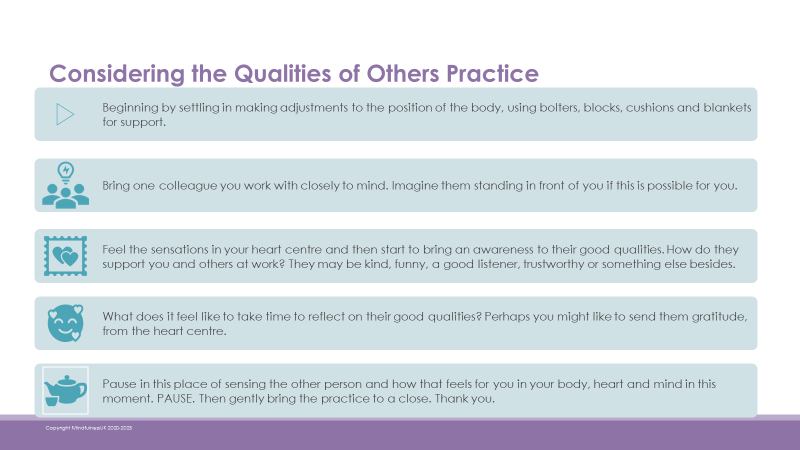
Considering the Qualities of Others Practice
Take some time to do this 5-minute practice, considering the qualities of others.
You can use the practice script card to guide you.
Compassion for others
In the following video Angie will take you through the benefits of feeling compassion for others and how to do this. (1.41 mins)
Emotional intelligence
What is Emotional Intelligence?
The talk by Karen is 11.08 minutes. Emotional intelligence (EI) is a type of social intelligence that builds resilience. This is done by developing traits and skills that increase the capacity for controlling one’s emotions as well as responding appropriately to the emotions of others. These can be learnt and developed over time. The World Health Organization considers EI to be one of the ten life skills that support people to act in an adaptable and positive manner.
Mindfulness meditation has proven to be effective in increasing the wellbeing of those who practice it, leading to better mental health, self-care and job satisfaction. These studies cited revealed a positive relationship between mindfulness and emotional intelligence, particularly the capacity to regulate emotions. Furthermore, mindfulness is negatively related to emotional exhaustion. Training interventions based on mindfulness have proven to be useful in promoting emotional balance, emotional awareness, emotional acceptance, emotion recognition, expressive suppression and a reduction in emotional exhaustion.
EI has been shown to positively influence a professional’s bio-psycho-social welfare, increasing their individual resilience, their perception of social support, empathy, job performance and satisfaction, and reducing stress. Developing the ability to manage emotions is critical to health and well-being, especially of those working in environments that hold significant emotional burden or there’s potential for secondary trauma. EI can lead to a reduction in stress and burnout, work absenteeism and is even a predictor of professional success.
By learning ways to increase our perception and expression of our emotions and those of others, we learn to assimilate and understand our emotions more comprehensively. Mindfulness and compassion then helps us to regulate our emotions and empathise with the emotions of those around us, contributing to our sense of control and empowerment so that we can choose to live our lives and build healthier, more resilient relationships, imbued with more ease, equanimity , maturity, joy and kindness.

The value of self-reflection in building positive relationships
As we start to become more mindful of our patterns and build self-compassion, our relationships to others can change as we soften and become more compassionate towards them. (6.24 mins)
Take some time to reflect on how being kinder to yourself and others at work may enhance your relationships with them:
How can I become kinder to myself?
How can I become kinder to others?
How might this create stronger, more positive relationships at work?