Module 4 - F: Feel self-compassionate
Welcome, to module 4.
This session teaches you the relationship between mindfulness and compassion, how to promote kinder communication at work, how to look after yourself more fully through self-soothing exercises and how joy can arise through caring for oneself at a deeper level.
This course is broken into a series of modules and lessons. On each module page you’ll find a table, just like the one below, where you can see the lessons available to you, and access the content.
To get started, simply click on the first lesson in the list.
When you have finished all of the lessons in the module, you’ll be returned to this page so that you can click “mark complete” under the table, and move to the next module.
Self-compassion

Each Moment is Precious by Patricia A. Fleming
Live in the moment,
Just take it all in.
Pay attention to everything,
Right there and right then.
Don’t let your mind wander
To what’s coming next.
Cherish this moment
And give it your best.
Don’t let tomorrow
Make you rush through today,
Or too many great moments
Will just go to waste.
And the person you’re with,
In that moment you share,
Give them all of your focus;
Be totally there.
Laugh till it hurts,
Let the tears drop.
Fill up each moment
With all that you’ve got.
Don’t miss the details;
The lesson is there.
Don’t get complacent;
Stay sharp and aware.
It can take but a moment
To change your life’s path.
And once it ticks by,
There is no going back.
In just 60 seconds,
You may make a new friend.
Find your true love,
Or see a life start or end.
You become who you are
In those moments you live.
And the growth’s not in taking
But in how much you give.
Life is just moments,
So precious and few.
Whether valued or squandered,
It’s all up to you!
Video about compassion (4.46 mins)
Self-soothing practice
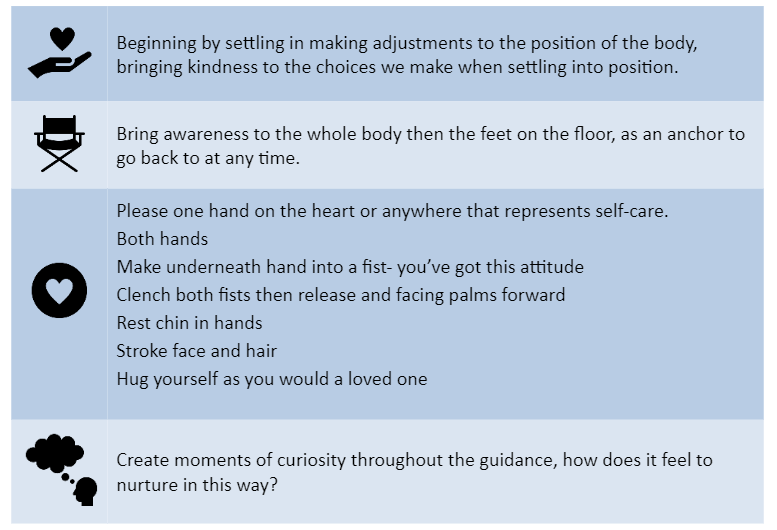
In the following video Karen will take you through a self soothing practice. (8.24 mins)
You can use the self-soothing practice script card to guide you.
In your journal…
After each practice spend a little time, perhaps a minute or two, in reflection, noticing what the experience was like, asking yourself questions such as those below.
You may want to make a note of these questions in your journal for ease of reference.
- What did you notice inside your body?
- Did you notice where in your body you felt emotions?
- Were you aware of what was happening in your mind?
- How did you react when you noticed what your mind was doing?
- Did bringing awareness to your thoughts change your experience?
- Is there a familiar pattern emerging here?
- Can you identify your experience with other areas of your life, your relationships for example?
- How do you think it would feel to bring compassion in here?
- How could you transfer what you have learnt through this practice to benefit your life?
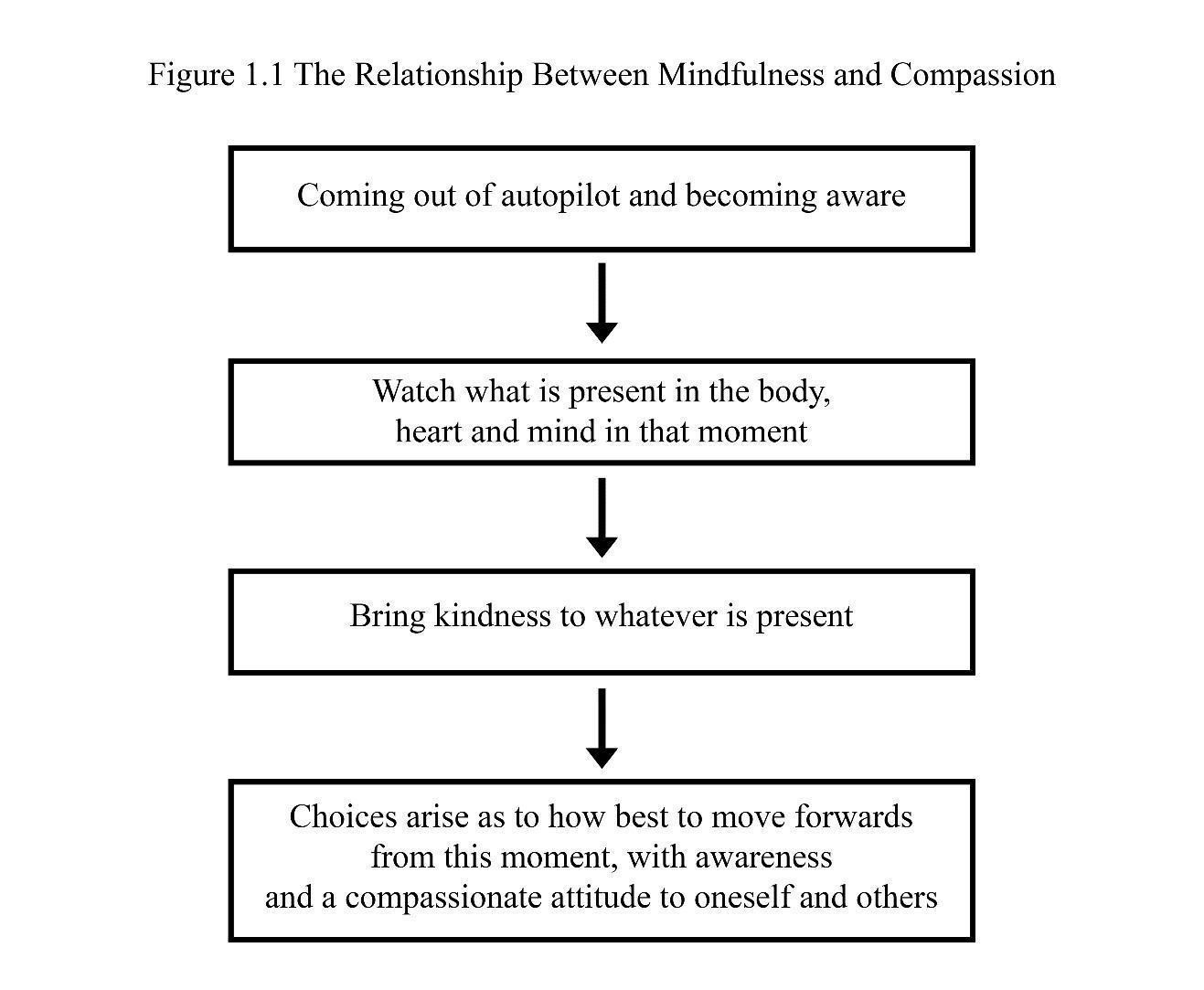
The relationship between mindfulness and compassion
Two wings of the bird
There is a useful image here which helps us to understand the relationship between mindfulness and compassion. If you consider a bird where one wing represents mindfulness and the other compassion then the bird has to have equal amounts of both to fly high in the sky. There is no point being present and not bringing kindness to that or being so compassionate but not have the wisdom of mindfulness to keep perspective and clarity.
Consider the Barriers to Joy
What is the mechanism that moves us from knowing about joy intellectually to living it? Sometimes it can feel like it’s a million miles away.
Take some time to consider what barriers your participants might have to experiencing joy. They might include some of the following:
- Not enough time
- Burdened with care-giving responsibilities
- Media
- Capitalism
- Too much to do in life
- Too tired
- Too expensive
Jewels of Joy Practice
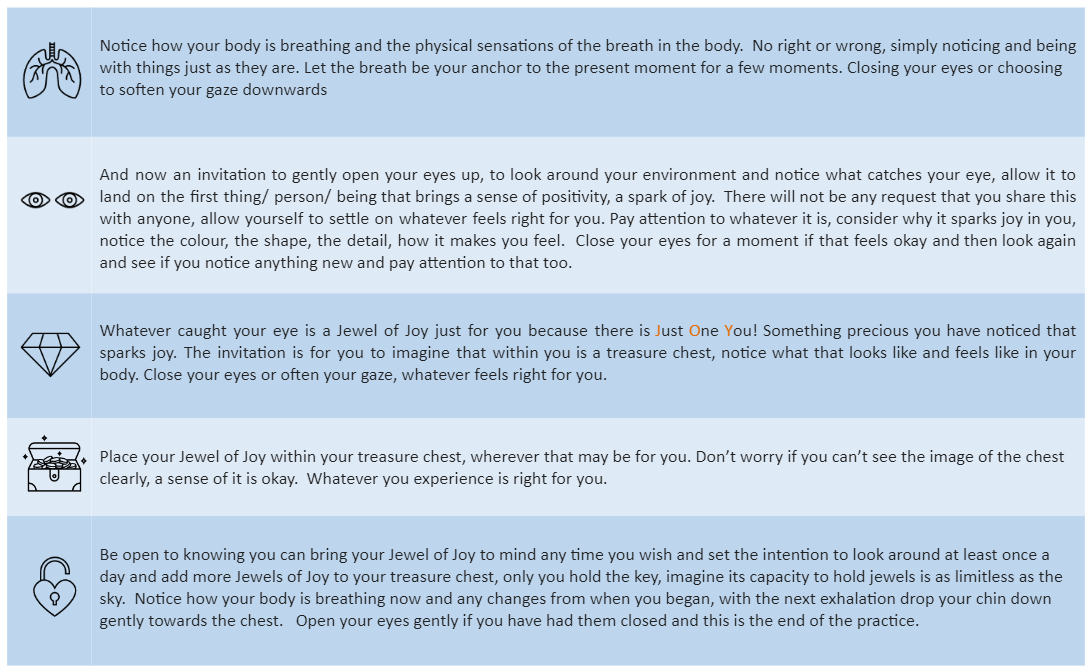
This practice helps to break down barriers and build more joy into our lives. (4.45 mins)
You can use the script card to guide you through the key points.
The Jewels of Joy poem by Angie Ward
Such a simple thing; the Jewels of Joy
Believe me, it’s not a gimmick or a ploy
It’s about seeking out the best things in your life
Like noticing the glisten of butter when you spread it with a knife
Watching the soft belly of a being rise and fall
Playing out and catching the ball
An intricate cobweb in the early morning dew
Shimmering like sunbeams for all to view
Warm food in your belly
Whilst you watch some good telly
A friendly smile
When you haven’t seen one in a while
A swim in the sea, a ride on a bike
An unexpected gift from one who heard what you like
It’s about being in your body
Even when you are feeling shoddy
Open your eyes and open your heart
Set the intention for this practice to start
And once it becomes habit, tell it to others
To colleagues and friends, parents, sisters and brothers
Allow it to ripple and uplift and shine
Pushing negativity back down the line
Changing Unsupportive Patterns Enables JOY
Mind Trap Talk (4.37 mins)
It is through the ability to sense into the relationship between our thoughts, emotions and physical sensations that we can see our habitual tendencies, usually developed through childhood in response to parenting and conditioning, which gives us the freedom to choose to do things differently from now on, resulting in a sense of empowerment, resilience and resourcefulness. Now that we are adults, new choices can be made to bring us joy and happiness beyond what we learnt in our earlier years and give us new perspectives on how to enrich our lives.
Through the non-judgemental identification of our patterns of resistance we can see that we can expend enormous amounts of energy trying to stop things from changing or wanting things to revert back to the way they used to be, rather than settling into the understanding that everything is impermanent and being OK with that.
It also sheds a very bright light on our predisposition to be reactive and do things very quickly in response to certain stimuli. Do you recall ever receiving a phone call, email or letter which precipitated an instant reply from you, only to wish later on that you had taken a little time to think about it some more, let it percolate and then respond more appropriately?
In essence what we are simply stopping, thereby cutting through autopilot, watch what arises in those moments of paying attention in the body, heart and mind and then bringing kindness to that.
This is where mindfulness and a compassionate approach intertwine. If we are critical or self-deprecatory of what arises in the moment then we are bringing aspects of our past, of our ingrained tendencies to the present moment which can be inappropriate at best and extremely damaging at worst.
If we are able to bring kindness to this, it builds resilience so that we can let go of the worry and let in joy.
We not only develop ingrained, habitual styles of thinking as we develop, but also habitual way of interacting with others. If these patterns are based on dysfunctional parent-child relationships, they may result in dysfunctional relationships with family, co-workers and others in your life today.
Mindfulness brings awareness to the dysfunctionality of relationships- their origins and how they manifest now. It helps to recognise and understand the past, acknowledging and validating experiences. Compassion practices help to soften around our behaviour and reactivity, allowing a sense of security, strength, patience, empathy and wisdom to manifest.
Meditation practice develops the qualities that help us recognise the needs and feelings, such that we take happiness from the joy and happiness of others as much as – or more than, even – from our own.

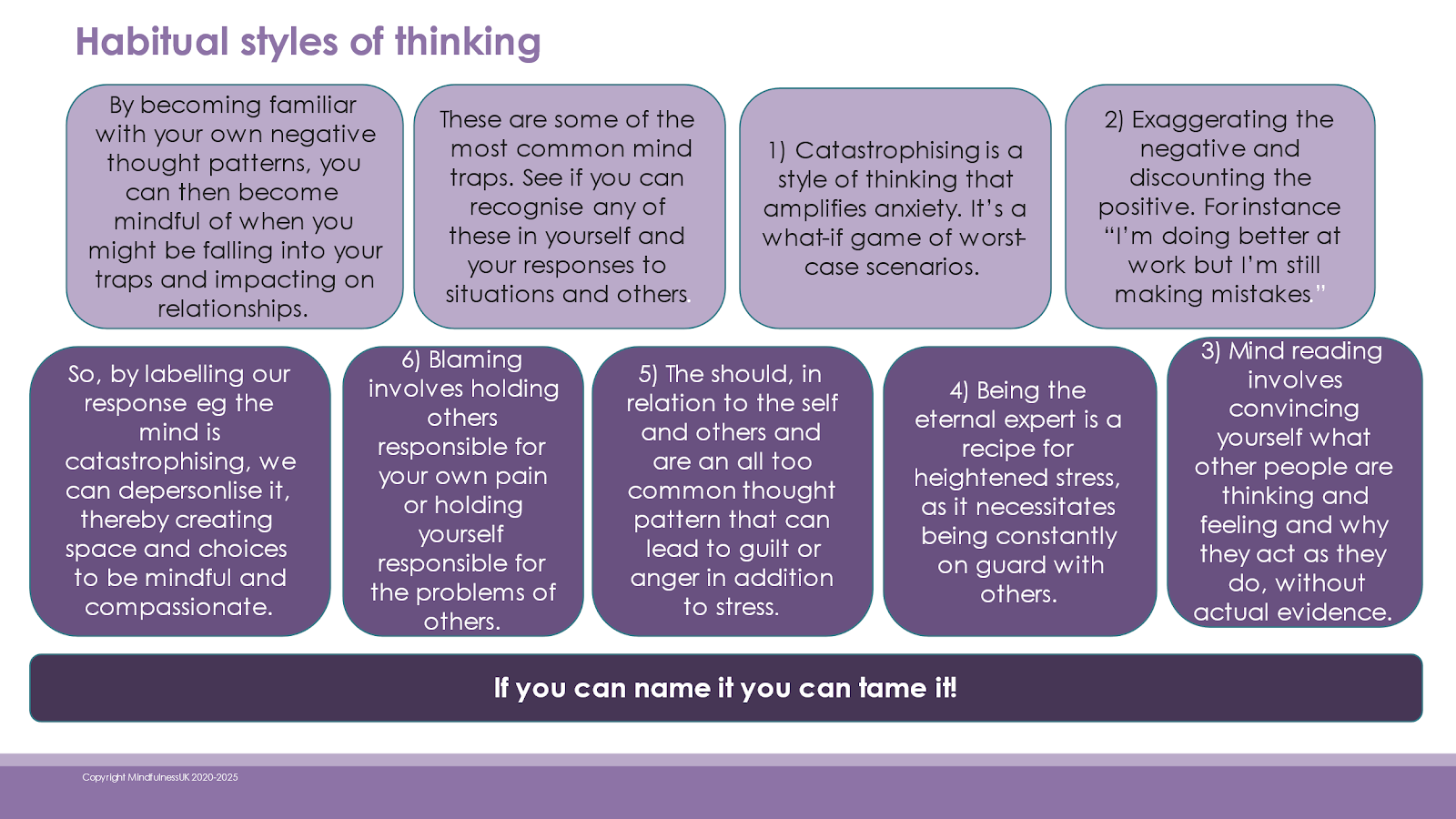
Exploring your habitual styles of thinking
Building on from the previous lesson, think about your own habitual styles of thinking.
Useful Questions for Exploration:
Think about the following questions. You might find it helpful you explore the answers in your journal to see what comes up for you.
What are your habitual styles of thinking?
What can you do when you are aware that you are triggered?
What are five ways to bring mindfulness to your workplace?
“Listen with curiosity. Speak with honesty. Act with integrity. The greatest problem with communication is we don’t listen to understand. We listen to reply. When we listen with curiosity, we don’t listen with the intent to reply. We listen for what’s behind the words.” — Roy T. Bennet, The Light in the Heart.
Building the Muscle of Gratitude
As with mindfulness and compassion, we can also build the muscle of gratitude which leads to higher levels of joy. Joy is how we develop resilience. By setting the intention to tap into this it makes us feel interconnected, like we’re participating in one part of a larger whole. Implementing the 10-finger gratitude practice, which is introduced later in this course, can also help you build your muscle of gratitude.
What do you do that brings you joy?
What could you do to bring more joy into your life?