Module 2: Understanding Compassion
Welcome, to the Compassionate Mindful Resilience course.
This course is broken into a series of modules and lessons. You may scroll down the lessons on each module, or use the links in the menus on the left to jump to any point within each module.
Mindfulness in daily activities
How to Begin with Mindfulness in Daily Life
Mindfulness can be introduced into every part of our daily lives. So often we do our daily activities on autopilot (like eating), and with mindfulness we can choose to notice that activity with a beginner’s mind, bringing a meditative approach to the ordinary.
Here are some ideas of activities where you can practice mindfulness:
- Mindful eating
- Brushing teeth
- Ironing
- Vacuuming
- Walking
- Washing up
- Showering
- Stroking a pet
Take a moment now and think about one activity that you do daily that you can bring mindfulness to – one that is in your daily routine such as brushing your teeth, boiling the kettle, chopping vegetables etc.
As part of this week’s practice, you are invited to bring a mindful approach to that activity every day for the next 7 days.
You may like to keep a diary of your mindful practice, you can always refer to the inquiry questions to help with your reflection
Mindful self-soothing practice and inquiry
Try this practice to start to experience what self-compassion feels like.
Not only does survival depend on the fight or flight instinct, it also depends on the “tend and befriend” instinct. In times of threat or stress, animals that are protective of their offspring are more likely to pass their genes successfully on to the next generation, meaning that care giving behaviour has a strong adaptive function. Hence mammals are born with an “attachment system”- see the work of Harry Harlow on rhesus monkeys and John Bowlby on attachment.
Although our experiences as an infant and child develop our inner belief systems and the way we treat ourselves, these can be changed, and exercises and compassion practices can be influential in this process. When we soothe our own pain, we are tapping into the mammalian care giving system. One important way this system works on a physical level is the triggering of oxytocin. This is a “hormone of love and bonding” and plays an important role in social relationships. Oxytocin has been shown to increase feelings of trust, calm, safety, generosity and connectedness and also facilitate the ability to feel warmth and compassion for ourselves. It reduces fear and can counteract the increased blood pressure and cortisol associated with stress.
Inquiry – take a moment and write down or reflect on how that practice was for you, which gestures soothed you and which didn’t.
Here are some more examples of other ways we can soothe ourselves, you may want to try them (or you may already do them):
- Hugging practice
- Stroking skin or hair
- Talking to yourself in terms of endearment
- Finding refuge - refuges include people, pets, memories, ideals, places, nature, teachers
- Touching the lips to stimulate the parasympathetic nervous system
- A big exhalation, or two
- A compassionate gesture
Introducing compassion
Compassion is a concept that is more familiar to most of us, and is something we often naturally bring into our relationships with others.
Compassion literally means “to suffer together.” Among emotion researchers, it is defined as the feeling that arises when you are confronted with another’s suffering and feel motivated to relieve that suffering.
When we have compassion for others, it is developed through the presence of these elements:
- Care and concern for others’ well-being
- Sympathy and empathy
- Positive effect
- Non-judgement
- Forgiveness
- Altruistic behaviour
- Engagement
- Self-compassion
Take a moment and reflect on what compassion means to you and how you bring compassion into your relationships with others.
Self-compassion
The compassion and kindness that we offer to others is something that we can bring to ourselves too, although this does not always come naturally to many of us.
What is self-compassion?
Dr Kristin Neff, a highly-regarded author in this space, has defined self-compassion as being composed of 3 components:
- Self-kindness,
- Mindfulness and
- Common Humanity.
Therefore self-compassion is about being kind to ourselves as opposed to ignoring internal suffering or pain and/or being self-critical.
Let’s dive a bit more into the detail of each of the components:
- Self-compassion requires kindness, that we be gentle and understanding with ourselves rather than harshly critical and judgmental. It is very common for us to outpour kindness and care to others whilst beating ourselves up about not doing enough, thereby placing ourselves under more pressure and reinforcing our self-critical and judgmental self.
To notice what self-kindness feels like, you can imagine that your best friend is with you, seeing the way you are behaving, and ask yourself what your friend might say to comfort and protect you? Another way to offer ourselves kindness is to find a term of endearment or a soothing phrase, to use when your inner voice starts criticising. Perhaps using something like, “sweetheart”, for instance, may be helpful. So, when things start to get difficult you can say “It’s OK sweetheart, it’s time to look after yourself, what is the best thing you can do right now to ensure self-care?”
- Recognition of our common humanity promotes feelings of connectivity with others in the experience of life, rather than feeling alienated by suffering. Tara Brach (another recommended author) writes “Feeling unworthy goes hand in hand with feeling separate from others, separate from life. If we are defective, how can we possibly belong? It seems like a vicious cycle: the more deficient we feel, the more separate and vulnerable we feel.”
Take a moment and reflect on your levels of self-compassion, maybe considering how you talk to yourself and how you look after yourself, and where you may want to choose to make changes.
Compassion fatigue & Secondary trauma
Compassion Fatigue
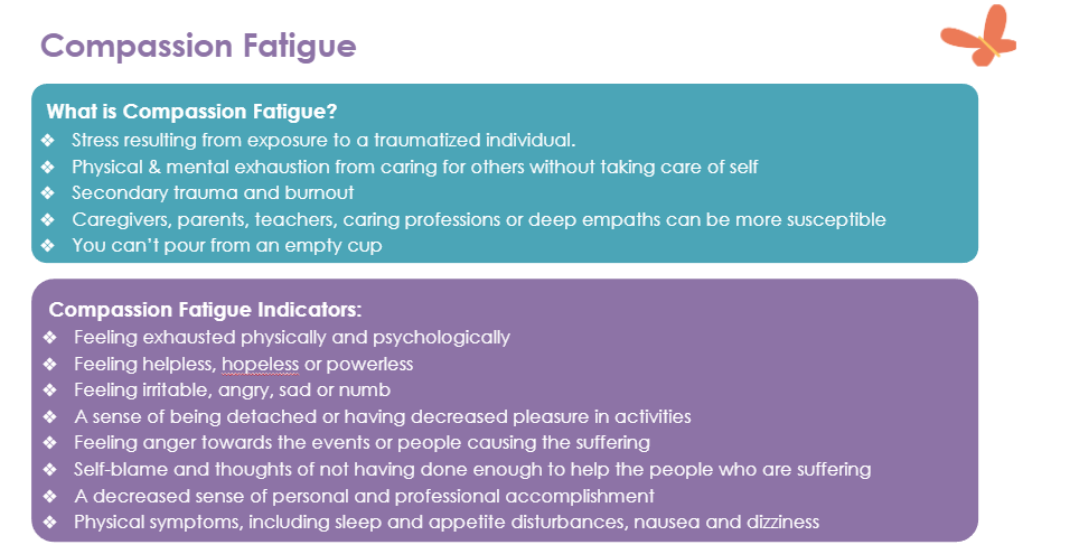
“Compassion fatigue (CF) is stress resulting from exposure to a traumatized individual. CF has been described as the convergence of secondary traumatic stress (STS) and cumulative burnout (BO), a state of physical and mental exhaustion caused by a depleted ability to cope with one’s everyday environment.”
— Taken from Compassion Fatigue among Healthcare, Emergency and Community Service Workers: A Systematic Review, Public Health, June 2016
Compassion fatigue is widely understood to have three separate but related dimensions: burnout, secondary traumatic stress and compassion satisfaction (Stamm, 2010).
Compassion fatigue can be experienced by those working in the helping professions, as a response to being exposed to the trauma of people who they are supporting (Figley, 1995).
To prevent ourselves feeling overwhelmed by pain, sometimes we have a tendency to tune out and shut down. This is what happens with care givers of any kind who have not developed the resilience for their work in supporting others, whether personally or professionally. By being compassionate to ourselves, we build the resources to be more genuinely compassionate to others without detriment to the self.
Secondary Trauma
“Secondary trauma describes when an individual has been exposed to difficult or disturbing images or events, whether directly or indirectly. It can often go unrecognised, and therefore untreated, for long periods of time and individuals can experience physical, behavioural and emotional or psychological symptoms.”
— (Institution of Occupational Safely and Health (IOSH) June 2020, (for Covid-19 workers)
- An occupational hazard – the human consequence of knowing, caring, and facing the reality of trauma (Saakvitne and Pearlman, 1996).
- The transmission of traumatic stress to helping professional through observing or listening to stories of traumatic events experienced by their clients (McCann and Pearlman, 1990).
How do Mindfulness and Compassion build resilience?
This course helps to identify what happens in our body, emotions and thoughts when we pay attention, whether doing a formal meditation practice or being mindful as we walk, talk, wash up, shower and so on.
This process of investigation is known as the inquiry process, where we become curious about our moment to moment experiences. This then gives us the opportunity to explore whether what we are doing is helpful and supportive, or whether it would be beneficial to make a choice to change our patterns of thought and behaviour.
Introduction to the process of Compassionate Mindful Inquiry
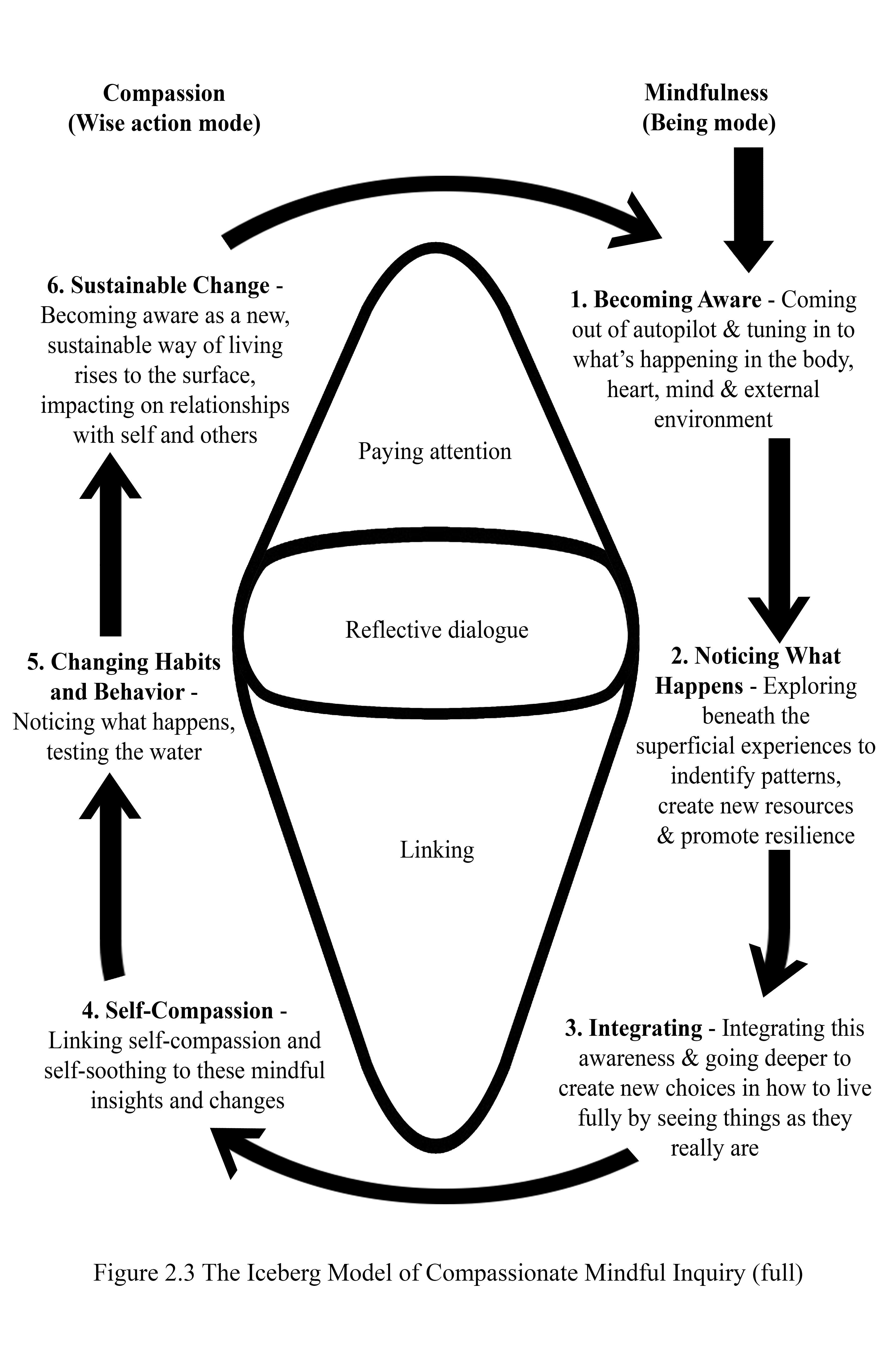
This model developed by Karen Atkinson, helps explain the journey that we are on, and the cyclical nature of the learning experience as we bring mindfulness and self-compassion into our daily lives.
Mindfulness builds resilience through equanimity, and compassion gives us the capacity to act upon what we have observed and accepted, with kindness.
We invite you to reflect on the model for a few moments, and use it as a reference tool as you work your way through the programme.
Practice for Module 2
Congratulations on reaching the end of Module 2.
Remember to take your time to practice, use your inquiry questions and journal, before moving on to module 3.
We recommend one week of practicing the Compassionate Body Scan and using the self-soothing practices especially in times of challenge.