Module 5: Developing Resilience
Welcome to module 5.
This course is broken into a series of modules and lessons. You may scroll down the lessons on each module, or use the links in the menus on the left to jump to any point within each module.
Practice: Affectionate breathing and inquiry
The following video takes you through the Affectionate Breathing practice.
Find somewhere private or put your headset on and listen to Karen guide you through the practice.
This video runs for about 10 minutes.
After the video has finished remember to do your inquiry.
Spend a little time, perhaps a minute or two, in reflection, noticing what the experience was like, asking yourself questions such as these:
- What did you notice inside your body?
- Did you notice where in your body you felt emotions?
- Were you aware of what was happening in your mind?
- How did you react when you noticed what your mind was doing?
- Did bringing awareness to your thoughts change your experience?
- Is there a familiar pattern emerging here?
- Can you identify your experience with other areas of your life, your relationships for example?
- How do you think it would feel to bring compassion in here?
- How could you transfer what you have learnt through this practice to benefit your life?
- Did you find it easy or difficult to connect with any sensations of breath in the body?
- What was it like bringing an attitude of kindness to your awareness of the breath?
Reading
Wild Geese by Mary Oliver
You do not have to be good.
You do not have to walk on your knees
for a hundred miles through the desert repenting.
You only have to let the soft animal of your body
love what it loves.
Tell me about despair, yours, and I will tell you mine.
Meanwhile the world goes on.
Meanwhile the sun and the clear pebbles of the rain
are moving across the landscapes,
over the prairies and the deep trees,
the mountains and the rivers.
Meanwhile the wild geese, high in the clean blue air,
are heading home again.
Whoever you are, no matter how lonely,
the world offers itself to your imagination,
calls to you like the wild geese, harsh and exciting —
over and over announcing your place
in the family of things.
Take a moment after reading the poem to reflect on what it means to you and how it felt to read it. Pull out your journal and make some notes about what came up for you.
Think about how you might take some of the lessons in this poem forward in your Mindfulness journey.
Qualities of interpersonal mindfulness – relationships
Through the rest of this module we’ll be looking at the following themes:
- Listening and communicating – thoughts are not facts
- Awareness within relationships – working with difficult situations
- Cultivating the ability and capacity to change reactivity in a more flexible way
Your Journal
Think about how to use mindfulness in your communications and relationships.
Slowly read Goethe’s short poem below. Savour and digest the words, ponder the meaning.
Write down your thoughts and reflections.
Lose this day loitering – by Johann Wolfgang von Goethe
Lose the day loitering, ’twill be the same story
To-morrow, and the next more dilatory,
For indecision brings its own delays,
And days are lost lamenting o’er lost days.
Are you in earnest? Seize this very minute!
What you can do, or think you can, begin it!
Only engage, and then the mind grows heated;
Begin it, and the work will be completed
Mindful relationships
Despite commonalities people can be an enormous stress in our lives. Positive emotions help us feel connected, whereas negative feelings such as dislike, hate, anger, resentment, intolerance, envy or jealousy – these all have their roots in feelings of separation.
Sometimes it can be the people we are most intimate with that cause us the most stress, maybe because there is more of a sense of responsibility or that they know you so intimately that they know which buttons to press.
Relationships have patterns.
We not only develop ingrained, habitual styles of thinking as we develop, but also habitual ways of interacting with others.
If these patterns are based on dysfunctional parent-child relationships, they may result in dysfunctional relationships with family, co-workers, and others in our lives today.
Mindfulness brings awareness to dysfunctional relationships, their origins and how they manifest now. It helps to recognise and understand the past, showing compassion and validating experiences.
Meditation for compassion
Meditation practice develops the qualities that help us put others’ needs and feelings above our own, such that we take happiness from the joy and happiness of others as much as – or more than, even – from our own.
Practice: 10,000 things
In the following audio Karen takes you through a practice for developing compassion, called 10,000 things.
After the video has finished, remember to do your after practice inquiry.
Spend a little time, perhaps a minute or two, in reflection, noticing what the experience was like, asking yourself questions such as these:
- What did you notice inside your body?
- Did you notice where in your body you felt emotions?
- Were you aware of what was happening in your mind?
- How did you react when you noticed what your mind was doing?
- Did bringing awareness to your thoughts change your experience?
- Is there a familiar pattern emerging here?
- Can you identify your experience with other areas of your life, your relationships for example?
- How do you think it would feel to bring compassion in here?
- How could you transfer what you have learnt through this practice to benefit your life?
Working with backdraft
Resilience prevents backdraft
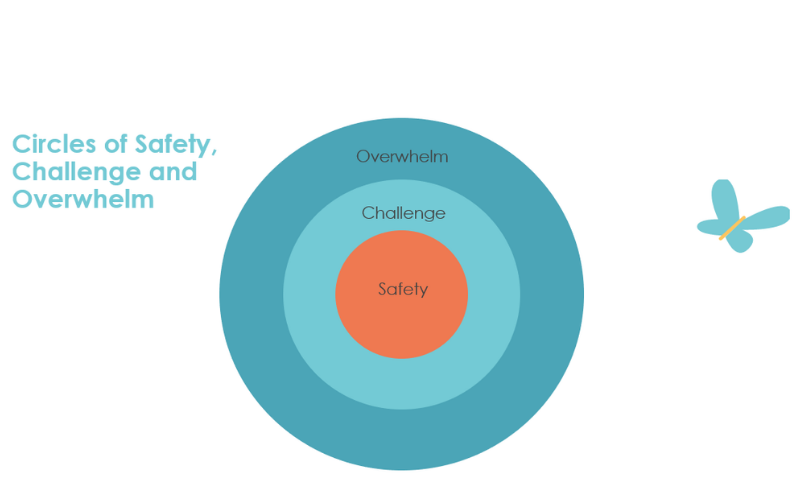
If self-compassion is new to you, it’s important to go at your own pace, thereby preventing backdraft (watch the video to understand more), represented by the circles of safety, challenge and overwhelm.
Remember, we all have a choice as to how much we do and can always return to the place of safety, using mindfulness and self-soothing exercises to steady us once more until we feel more resilient and resourced.
Circles of safety, challenge and overwhelm
What can we do?
We all have a choice as to how much we do , and can always return to the place of safety, using mindfulness and self-soothing exercises to steady us once more until we feel more resilient and resourced. As you look through the descriptions below, think about situations where you have been in your circle of safety, challenge, and overwhelm.
Safety
When in this circle, there is a sense of comfort, calmness and ease in the body and mind. Safety has that feeling/sound of a deep exhalation, “Ahhhhhhh.” While holding back from engaging sometimes happens here, keep in mind this circle is the foundation of learning, and it’s really helpful to know how to move to this circle. (Grounding practice, Breath)
Challenged
This circle is where we learn the most. Signs of challenge include:
- Being engaged and receptive to learning
- The ability to actively integrate what you are learning into daily life
- Posture is alert rather than rigidly tense
- Mind is more open, and open to possibility rather than constricted
*Consideration: It’s helpful to notice where you are in the challenge circle- closer to safe or overwhelm? If close or moving towards overwhelm, it is skilful to move back to safety. We don’t have to ride the edge of overwhelm to learn and grow. Can you take a more self-compassionate stance and stay solidly in the challenge circle, with a bit of a buffer between challenge and overwhelm?
Overwhelmed
Though different for everyone, some signs of overwhelm could be:
- Feeling flooded with emotion, often challenging emotions
- Body posture is tense/tight, (maybe even body aches or pain)
- The mind may be racing and/or thoughts may be fear-based or reactionary
When we become overwhelmed- and let’s face it we all do from time to time- we must go all the way back to safety and hang out here until our physiology recovers. We cannot go from Overwhelm to Challenge. Safety is the foundation for learning. Then, the amygdala calms and the prefrontal cortex comes back online. In other words, coming back to safety actually resets the brain’s ability to learn. Read more about how to find safety below.
Practice for Module 5
Remember to take your time to practice, use your inquiry questions and journal, before moving on to module 5.
Practice the affectionate breathing this week and really consider what practices you can do to bring you back into the circle of safety.
Do continue to bring mindfulness to your daily activities and make the other practices a part of your routine.